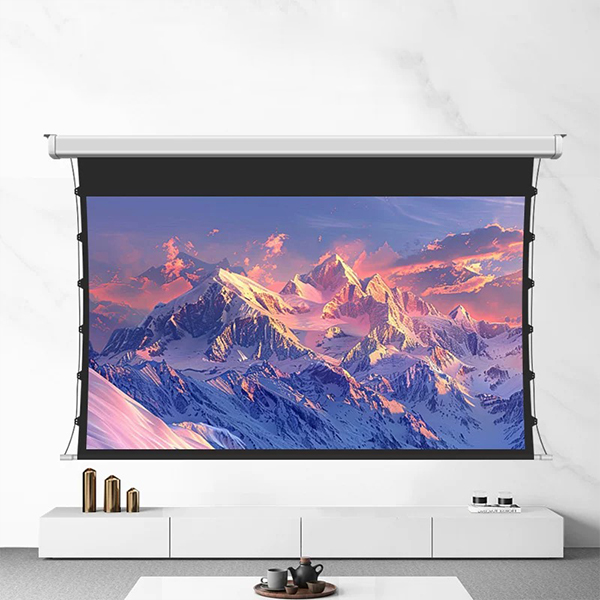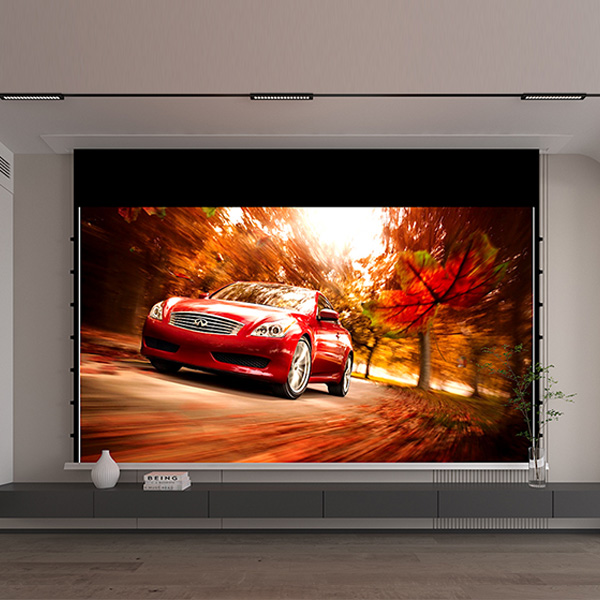

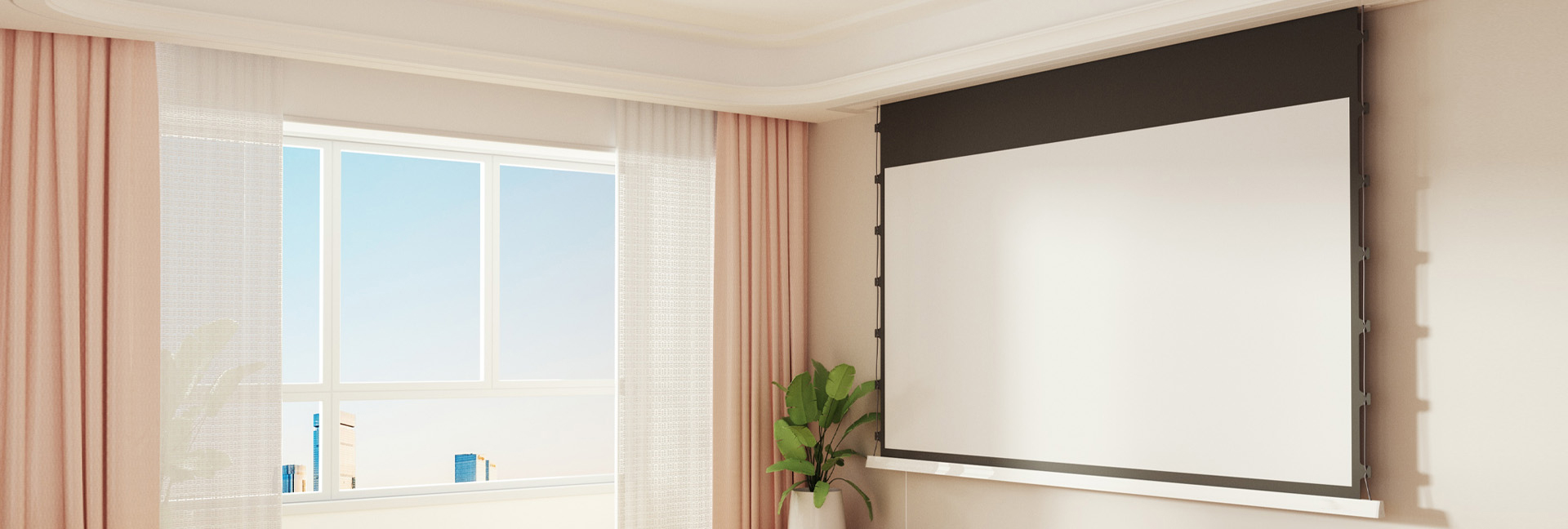
In recent years, home projection has undergone a quiet but profound transformation. As projectors increasingly converge in brightness, resolution and light-source technology, the screen—long regarded as an accessory—is redefining the boundaries of home cinema through breakthroughs in optical structures. During the first half of 2026, a wave of technological innovations closely tied to household applications has emerged, spanning optical microstructures, materials engineering, product form factors and cost structures. The projection screen is evolving from a passive reflective surface into an active optical terminal.
Optical Microstructures Evolve: Micron-Level Micro‑Mirror Arrays Precisely Reconfigure Reflection Paths
In February 2026, China’s National Intellectual Property Administration published a patent titled “A Semi‑Cylindrical Micro‑Mirror Micro‑Optical Projection Screen” (authorization number CN223897761U), filed by Hubei Yimeite Holographic Technology Co., Ltd. in April 2025. The design places an array of concave semi‑cylindrical micro‑mirrors on the back of the substrate layer. The vertically arranged mirrors gradually increase their angle from bottom to top, redirecting light that would otherwise scatter upward or downward toward the viewing area and effectively improving reflective gain. At the same time, the vertical semi‑cylindrical concave mirrors effectively diffuse projection light and increase horizontal viewing angles. This trend indicates that the industry is moving from a traditional “uniform diffuse reflection” approach toward an optical‑control logic based on precisely directed reflection—laying the foundation for high‑quality, wide‑angle viewing in complex residential lighting environments.
Fresnel ALR Technology Leads the Way: From Lab Parameters to Real‑World Usability
Fresnel‑structured screens have become the most closely watched technology route in the home projection screen field in recent years. In the first quarter of 2026, multiple brands intensively launched next‑generation Fresnel ALR products, with a clear technology roadmap: maintain high ambient‑light rejection while prioritizing long‑throw compatibility, wide viewing angles, high gain, and motorized concealment—features that directly improve everyday living‑room usage.
FSCREEN introduced its world‑first OMNIS long‑throw Fresnel 5.0 electric screen, achieving 85% ambient‑light rejection and a gain of 1.2×. Tests show that even in a daylight living room with open windows and no curtains, 4K content remains sharp and detailed, delivering over 40% better clarity than ordinary white matte screens. Meanwhile, the JCONG Fresnel hard screen uses a multi‑layer optical design to achieve ambient‑light rejection of 83% to 94%; under 500 lux of ambient light (equivalent to a typical bright living room), brightness loss is under 15%, and contrast is more than three times higher than that of ordinary white matte screens. JCONG also realizes a wide 160°±5° viewing angle, addressing the long‑standing pain point of narrow viewing angles and off‑color edges associated with traditional ALR screens, so that family members can enjoy consistent, comfortable visual experiences from different seats.
On the gain front, performance ceilings are also being pushed higher. The Weisi F1 Fresnel hard screen delivers a gain of 1.8×, increasing center brightness by 80% compared to a standard 1.0× white matte screen; subsequently, other manufacturers have pushed gain toward 2.8×. In color performance, through optimized prism structures and coating processes, various products have reduced color offset ΔE to within 2, with color accuracy and 8K content compatibility continuing to improve.
Cost Barriers Broken: Sub‑$100 ALR Screens and Tool‑Free Installation Reshape the Market
Another major change in the first half of 2026 has been the large‑scale emergence of sub‑$100 ALR screens and the wide rollout of tool‑free installation solutions, which make high‑quality viewing accessible without buried pre‑wiring or professional installation teams.
Products such as Junqirui’s ALR metal screens use a sub‑$100 price point and tool‑free design to reconfigure the entry barrier for high‑quality imaging ecosystems. A folding hook system exploits the screen’s own weight (approximately 0.8 to 1.2 kg) and static friction to create a passive tensioning mechanism. No drilling, no brackets, no adhesive: users simply hook the screen over a window frame or ceiling edge and instantly deploy an ALR surface on any wall. Sizes from 100 to 133 inches suit a variety of scenarios from living rooms to studies, while a 120‑inch screen folds to about 30 cm in length—lighter than a thick dictionary—making it highly portable and scene‑agnostic.
Behind this shift are maturing supply chains and falling material costs. Industry data shows that capacity utilization in the projection screen sector was around 55% in 2025, with an average gross margin of about 30%. ALR screens, leveraging differentiated technological value, offer households an upgrade path to “all‑day viewing freedom at a sub‑$100 investment.”
Electric Floor‑Rising and Mobile Scenarios: From Fixed Installation to Flexible Deployment
Electric floor‑rising and motorized roll‑up screens are emerging as another significant growth segment in the home market. JCONG’s 2026 releases feature an integrated floor‑standing box design that completely eliminates in‑ceiling pre‑wiring and wall drilling. Four lockable silent casters at the base allow a single person to easily move the 100‑inch model weighing no more than 18 kg, enabling flexible transitions across living rooms, bedrooms, balconies and even outdoor settings—particularly appealing to renters with installation constraints. On the noise front, custom DC silent motors keep operating noise below 30dB, comparable to library background levels.
Patent activity focused on portability and ease of use is also accelerating. In late May 2026, Elite Screens (Huizhou) Technology Co., Ltd. received a patent for a movable projection screen (authorization number CN224287333U) filed in August 2025. Also in late May, Shenzhen Daping Yingyin Technology Co., Ltd. received a patent for a screen rolling cleaning mechanism (authorization number CN224298462U) that cleans the screen surface during roll‑up. Meanwhile, Anker Innovations secured a design patent for a projection screen in mid‑May 2026; the company has obtained 178 new patents this year, a year‑on‑year increase of 33.83%. These patent activities signal that competition is expanding from basic optical performance to structural design, ease‑of‑operation and overall user experience.
Ecosystem and Ancillary Technologies: Upstream Materials and Downstream Applications Converge
Across the broader industrial chain, projection screen innovation is resonating with light‑source developments, display standards and international market demand. In March 2026, a projection screen patent jointly filed by Hisense Laser Display Co., Ltd. was published (publication number CN115933301B), achieving innovations in structural integration of roller assemblies and drum components and further improving the electric‑screen technology ecosystem. In the vehicle and mobile entertainment arena, Fuyao Glass Industry Group Co., Ltd. published a patent for a projection screen assembly and vehicle in February 2026 (publication number CN121522945A), extending the application of projection screens to automotive scenarios. At the upstream materials level, representative suppliers include DuPont, Toray Industries, Teijin, Hydro, Aluminum Corporation of China and Nanshan Aluminum, whose optical‑grade substrates are critical enablers of screen technology innovation.
Global Outlook: Global ALR Projector Screen Market to Reach $3.76 Billion
According to the latest study by Global Info Research, the global Ambient Light Rejecting (ALR) projector screen market was valued at US$2.367 billion in 2025 and is forecast to reach a readjusted size of US$3.764 billion by 2032, with a CAGR of 6.8% during the review period. In 2025, global production reached 1.15 million units at an average price of US$2,000 per unit, with capacity utilization of about 59% and an average gross margin of around 40%. The research defines ALR projector screens as “projection screens engineered with directional optical microstructures and light‑absorbing layers to reject off‑axis ambient light while preferentially reflecting projected light toward viewers, improving perceived contrast in bright rooms”. Downstream demand is split between home and commercial use, with the home segment driven by living‑room projection upgrades and ultra‑short‑throw installations, and the commercial segment concentrated in corporate meeting rooms, education, and premium presentation spaces—serving customers such as WeWork, New Oriental Education and Wanda Cinemas.
At the same time, the global 4K projector screen market is expanding steadily. According to the latest QYResearch survey, China’s 4K projector screen market is projected to reach US$3.153 billion by 2032, with a CAGR of approximately 6.0% from 2026 to 2032.
Outlook: The Screen Evolves from an Accessory into the Optical Operating System of Home Theater
Synthesizing the above industry dynamics, the positioning of projection screens is undergoing a fundamental shift. In the home environment, users no longer need to sacrifice natural lighting for an immersive viewing experience, nor do they need to undertake costly and complex installation projects. Through precise optical microstructures, continuous iteration of Fresnel ALR technology, and the large‑scale rollout of sub‑$100 solutions, the screen is becoming the “optical operating system” of the home‑entertainment ecosystem—the core decision layer that controls light path, image quality and environmental adaptability.
Looking ahead, what determines the upper limit of viewing quality in home entertainment may no longer be the lumen race among projectors, but how to ensure that every beam of light truly “serves the picture.”